- Published on
From 'Alinhar' to 'Golaço': What Five Years of Remote Work Taught Me About Brazilian Corporate Culture
- Authors

- Name
- Ergito Vilanculos
From my first call with the CEO of a company I worked with, what I remember most is one sentence: "puta golaço".
For a second, I thought I had misheard. Where I came from, I would never expect a CEO to talk like that on a call. That moment was my real onboarding into Brazilian corporate culture.
I have been working remotely from Maputo with Brazilian teams for five years now. This post is about what I learned along the way: the language, the culture behind it, the scale of the work, and how to build real relationships from about 8,000 kilometers away.
Informal on the Surface
The first thing you notice in Brazilian tech teams is how informal communication is. Not in a careless way, in a human way.
- Hierarchy does not set the tone. Interns, tech leads, directors and C-levels talk to each other in the same relaxed register, usually by first name.
- Humor is part of the job. Jokes in the daily, memes in the team channel, emojis as a valid answer to a question.
- Football is a second language. A great delivery is a golaço (a stunning goal), and football metaphors show up in meetings all the time.
About that CEO: "puta golaço" is roughly "what a f***ing great goal", the kind of thing you shout at a stadium. In that context, it simply meant something had gone very well. The startled one was me.
NOTE
If you come from a more formal business culture, the informality can feel like a lack of seriousness. It is not. It is a sign of psychological safety: people speak openly because they are not afraid of the hierarchy.
Rigorous Underneath
Here is the part that took me longer to understand: the relaxed tone hides a very demanding environment.
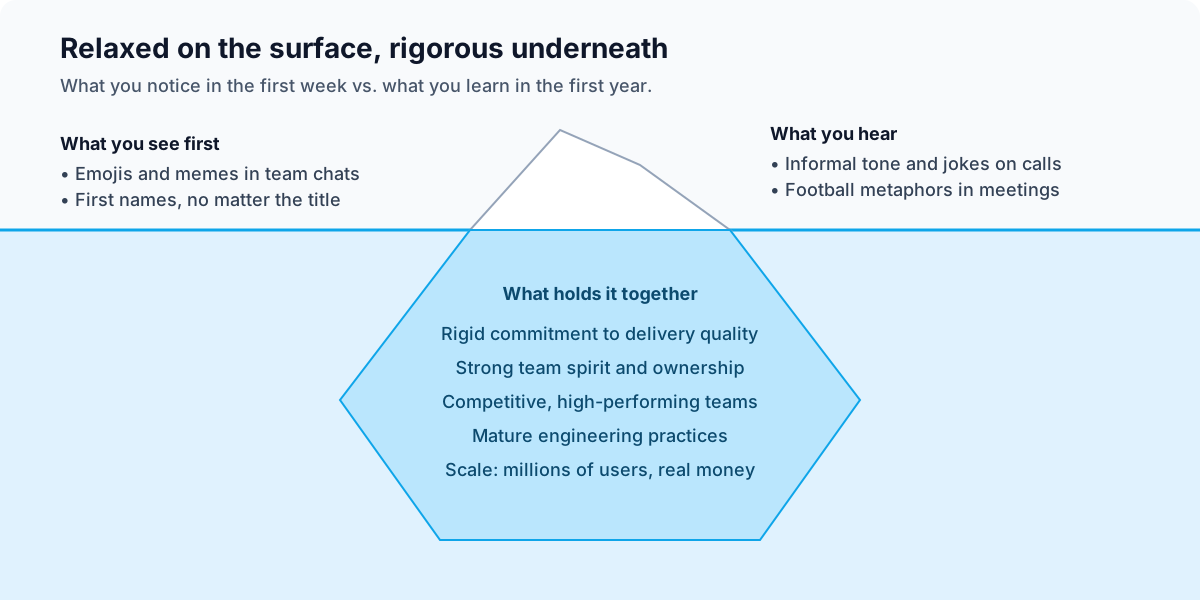
Under the jokes, I found:
- A rigid commitment to delivery quality. Code reviews are thorough, acceptance criteria are taken seriously, and "it works on my machine" does not survive the first review.
- Real team spirit. When something breaks in production, people show up, regardless of whose code it was. The problem belongs to the team.
- Competitive environments. The market is large and full of talented engineers. You are expected to perform, to grow and to keep up with a fast pace.
The lesson: do not confuse informal with easy. You can laugh in the daily and still be held to a very high standard at the pull request.
The Vocabulary Nobody Teaches You
Brazilian tech teams have their own dialect: Portuguese mixed with English, with meanings you will not find in a dictionary. Some of the terms I use every day:
| Term | Literally | What it actually means |
|---|---|---|
| Alinhar | to align | To sync and agree on something. "Vamos alinhar?" usually means a quick call. |
| Puxar uma task | to pull a task | To pick up a ticket from the board and own it. |
| Refinamento | refinement | The backlog refinement ceremony, where stories get detailed and estimated. |
| Subir para produção | to go up to production | To deploy. "Subiu?" means "is it live?". |
| Daily | (English) | The daily stand-up. Many ceremonies keep their English names. |
| Dar um toque | to give a touch | To give someone a heads-up or a nudge. |
| Quebrou | it broke | Something failed, usually in production. Never a good word to read at night. |
| Débito técnico | technical debit | Technical debt. |
| Bora | let's go | Agreement and energy at once: "let's do it". |
| Golaço | a great goal | An excellent result. The highest praise you can get. |
TIP
When you do not understand a term, ask. Brazilians are generous about explaining their slang, and asking is often the start of a good conversation.
"Alinhar" deserves its own section
If I had to pick one word that defines Brazilian corporate communication, it would be alinhar.
It reflects a culture that values consensus and relationships. Before a decision, people want to make sure everyone is on the same page. For someone working five hours ahead, that has a cost: many "alignments" turn into calls at the end of my day. I wrote about how I deal with that in Working 5 Hours Ahead.
My practical answer is to align in writing first. A clear message with context, the decision needed and a default often makes the call shorter, or unnecessary.
Building Software at the Scale of a Country
The cultural lessons are only half of the story. The other half is scale.
Brazil has about 213 million people (Agência IBGE Notícias, 2025). Mozambique has about 34 million (Club of Mozambique, 2025). In Brazil, I worked on apps with more than 20 million monthly active users: a single app reaching more people than half of my home country's population.
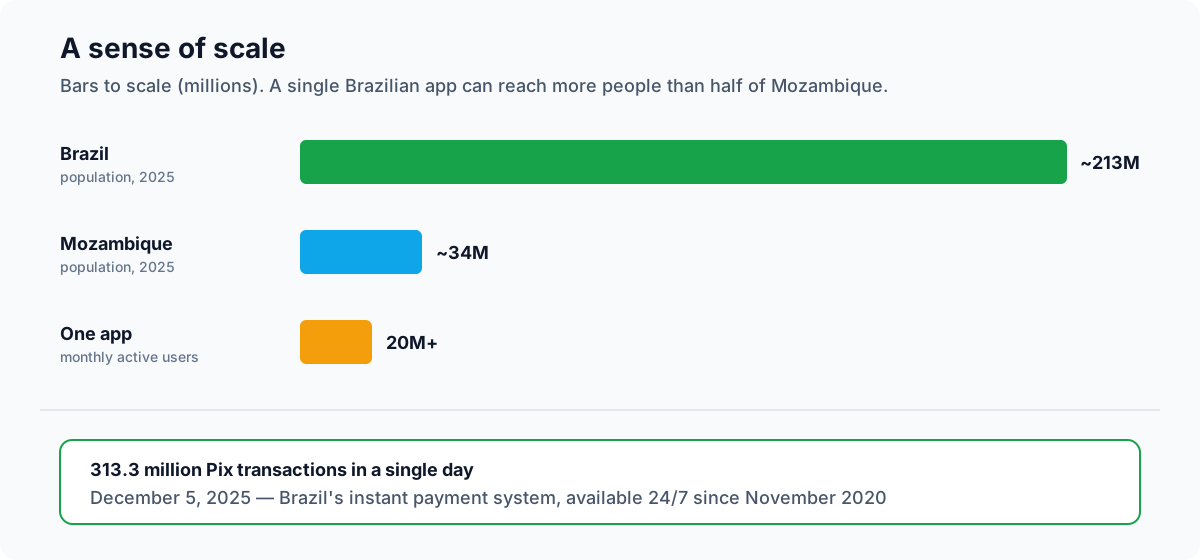
At that scale, everything changes:
- Small percentages are huge numbers. A 0.1% error rate can mean thousands of people affected.
- Peaks are brutal. Paydays, Black Friday and campaign launches multiply traffic in minutes.
- Every incident is visible. Users notice, social media notices, and the business feels it immediately.
This is not a criticism of smaller markets. Mozambique has its own innovative ecosystem, especially in mobile money: I integrated M-Pesa and e-Mola payments at Leeva Studio, and those platforms solve real problems for millions of people. But the transactional volume of the Brazilian market is on a different order of magnitude, and working inside it reshaped how I think about reliability.
A Mature Financial and Payments Ecosystem
Nothing illustrates Brazil's technological maturity better than its payments ecosystem.
Pix, the instant payment system created by the Central Bank of Brazil, has been live since November 2020. It works 24/7, settles in seconds, and has become part of everyday life for individuals and businesses. On December 5, 2025, it processed 313.3 million transactions in a single day (SBT News, 2025).
For an engineer, integrating with an ecosystem like that teaches a lot:
- Instant means no second chances. Money moves in seconds, so validations, limits and fraud checks have to happen before, not after.
- Idempotency is not optional. Retries, duplicated callbacks and timeouts are normal, and a payment must never be processed twice.
- Regulation is part of the architecture. Security, auditability and compliance requirements shape the design from day one.
- Observability is a business requirement. When payments slow down, someone loses money, so you need to know before the user does.
Working in this ecosystem showed me how high the technical bar can be, and how much competence exists in Brazilian engineering teams.
Networking from 8,000 Kilometers Away
Working remotely, there is no coffee machine, no lunch with the team, no casual conversation in the hallway. Relationships do not happen by accident. You have to build them on purpose. What works for me:
- Be present in written channels. Answer questions, share what you learned, celebrate other people's deliveries. Visibility in remote work is built in writing.
- Turn the camera on. It sounds small, but people connect with faces. Informal cultures value that closeness.
- Make room for small talk. In Brazil, the first minutes of a call are often about football, the weekend or the weather. Do not rush them. That is where trust is built.
- Offer help before you need it. Pairing on someone's bug or reviewing a pull request carefully creates more connection than any networking event.
- Share knowledge in public. Internal talks, documentation and posts like this one make your work visible beyond your own team.
- Keep in touch after the project ends. A message on LinkedIn when someone changes jobs, or a congratulation on a promotion, keeps relationships alive.
IMPORTANT
Remote networking is not about being liked by everyone. It is about being known for something: reliability, clear communication, technical depth, or simply being the person who helps.
What I Would Tell Myself Five Years Ago
- Do not mistake informality for a lack of seriousness. The quality bar is high.
- Learn the vocabulary. Alinhar, puxar uma task, refinamento: it makes you part of the team faster.
- Align in writing first, especially across time zones.
- Respect the scale. At millions of users, every detail matters.
- Build relationships on purpose. Remotely, they will not happen by themselves.
Five years later, I no longer get startled by a golaço in a meeting. And when a delivery goes really well, I have caught myself thinking the same word.